
Why one bad answer in an interview doesn’t have to kill your chances.
Why a Shakey answer doesn’t kill your interview.
Here’s something most people get wrong about job interviews.
You’ve probably heard that interviewers make up their mind about you within the first few minutes - and honestly? That’s true. After 15 years in recruitment, I can tell you that we all make snap judgements about the people we meet. It’s human nature. It’s why so many organisations now put their people through unconscious bias training - because that instinct is real, and it matters.
But here’s what people don’t tell you: that first impression isn’t the whole story.
The unconscious points scoring system
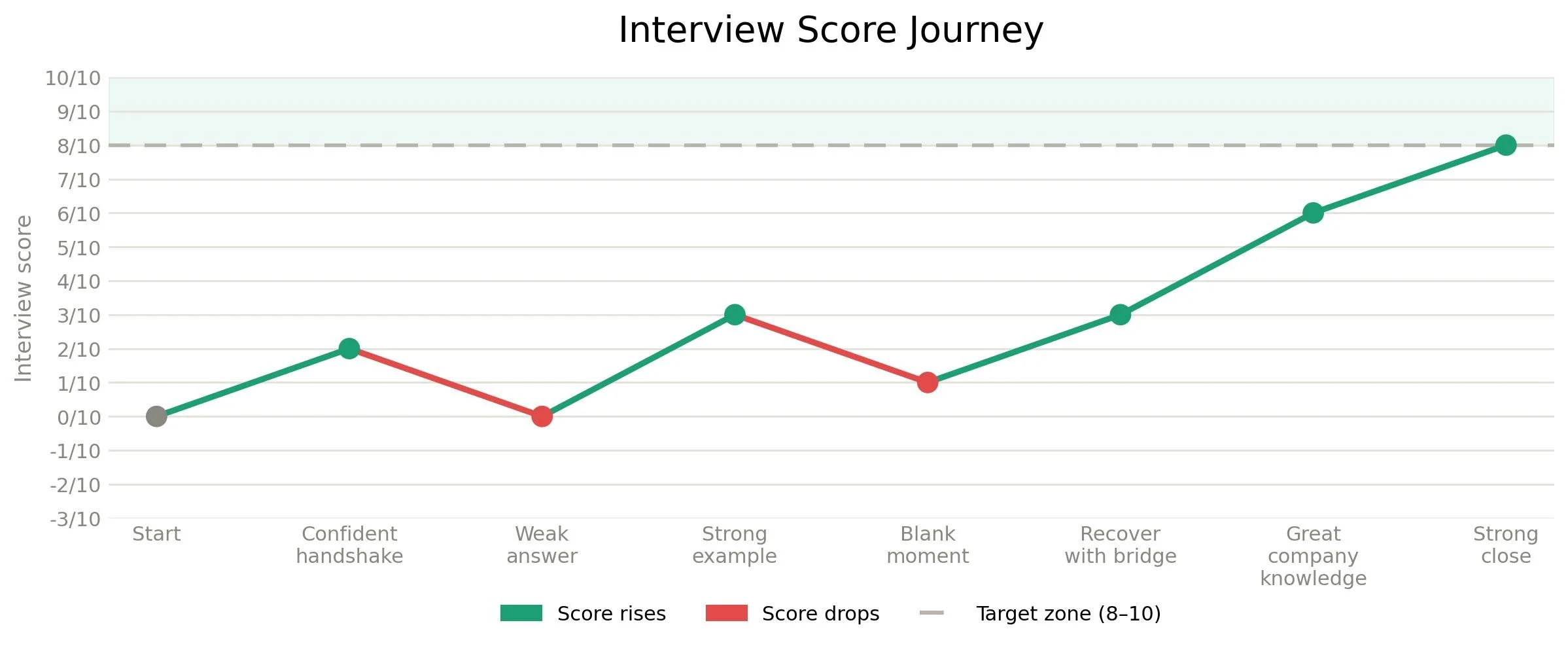
I’ve placed plenty of people who, on first meeting, I thought would be average - and they went on to absolutely nail it by the end of the interview. How? Because interviews don’t work on a single yes/no decision. They work more like a running scoreboard.
I call it the unconscious points scoring system, and I genuinely believe every interviewer has one operating in the back of their mind.
Here’s how I explain it to my clients: to get the job, you need to finish the interview at around 8 or 9 out of 10. And your score moves up and down the whole way through - based on how you answer questions, how you carry yourself, how you recover when things don’t go perfectly.
What moves your score up - and down
Everyone walks in at zero. Here’s the kind of thing that shifts it:
Things that drop your score:
• A limp or awkward handshake - minus two before you’ve said a word
• Arriving flustered or late - minus two, and you’re already on the back foot
• Being underdressed for the role - minus one, because it signals you didn’t take it seriously
• A vague or rambling answer - minus one, especially if the question was straightforward
• Badmouthing a previous employer - minus two, this one’s a big red flag for most interviewers
• Blanking on a question completely and not recovering - minus two
Things that lift your score:
• A confident handshake and a warm, genuine smile - plus two, straight away
• Arriving calm and a few minutes early - plus one
• Being well-presented and appropriate for the role - plus one
• A clear, structured answer with a real example - plus two
• Showing genuine knowledge of the company and role - plus two
• Asking a thoughtful question that shows you’ve done your homework - plus two
The point isn’t to memorise a checklist. It’s to understand that every interaction is an opportunity to add to your score - and that a dip here and there won’t sink you if you keep showing up well everywhere else.
How to recover mid-interview
Everyone has a moment in an interview where something doesn’t land the way they wanted. A question catches you off guard, you ramble, you go blank. It happens to everyone - including strong candidates.
The difference between candidates who recover and those who don’t is usually what they do in the thirty seconds after it happens.
Pause before you answer
Most people rush to fill silence, and that’s where rambling starts. Taking a breath and a moment to think isn’t a weakness — it signals composure.
Ask to come back to it
If you genuinely don’t know how to answer something in the moment, it’s completely okay to say “That’s a great question - can I come back to that one?” Most interviewers respect that far more than a fumbled non-answer.
Reframe and move forward
If you’ve just given a weak answer, don’t dwell on it. Mentally note it, let it go, and put your energy into the next question. Candidates who visibly beat themselves up mid-interview make the interviewer uncomfortable - and it costs more points than the original slip did.
Use a bridge
If you feel like you didn’t get your point across, you can add to a previous answer naturally: “I just want to add something to what I said earlier about X - I think a better example would be…” Interviewers appreciate that. It shows self-awareness.
The goal isn’t a perfect interview. The goal is to keep your score moving upward overall.
Don’t forget the end of the interview
A lot of candidates think the hard work is done once the last question is answered. It isn’t.
The final few minutes of an interview carry real weight - and they’re often where scores shift significantly in one direction or the other.
Ask good questions
This is your chance to add two or three points to your score in one move. Prepare two or three genuine questions about the role, the team, or the direction of the business. Avoid anything about salary or holidays at this stage - that comes later. A question like “What does success look like in this role in the first six months?” tells the interviewer you’re already thinking about how to do the job well.
Confirm your interest
Don’t leave the interviewer guessing. If you want the role, say so. Something like “I’ve really enjoyed this conversation and I’m genuinely excited about this opportunity” costs nothing and lands well. Most interviewers are hoping to hire someone who actually wants to be there.
Close with warmth
Thank them for their time, shake hands again, and leave the room the same way you walked in - with confidence. The interview isn’t truly over until you’re out of the building. Receptionists talk.
Think of the close as your last chance to bank a few final points. Use it.
Ready to prepare properly?
If you’d like help preparing for your next interview - including how to handle the tough questions and finish strong - get in touch at itsmylife.co.nz. That’s what I’m here for.