
Your Job Search is like going out for dinner
This analogy will change the way you think about your Job Search Process
Your LinkedIn, your CV, your interview — they all play a different role in getting hired – so how do you connect them all?
“Success is not final, failure is not fatal: it is the courage to continue that counts”
The three-part framework at a glance:
Step 1 — LinkedIn: The chalkboard/sign outside
Step 2 — CV: The menu
Step 3 — Interview: Asking the waiter
LinkedIn is the chalkboard/sign outside
Before anyone walks into a restaurant, something has to catch their eye first. It’s the handwritten chalkboard propped up on the pavement — today’s special, a headline dish, maybe a witty line that makes a passerby stop and think “I want to eat there.” It’s the very first impression, working on everyone walking past, whether they were looking for a restaurant or not.
It also lets people know what type of restaurant it is – you know it’s an Italian Restaurant, or a fish restaurant etc by just looking at the signage outside.
That’s your LinkedIn profile. It’s your always-on, public-facing presence — discoverable by recruiters who weren’t looking for you specifically, visible to hiring managers doing their research, and the first thing most people see before they’ve formally engaged with you at all.
“The chalkboard doesn’t need to list every dish — it just needs to easily showcase you .”
A great LinkedIn profile has a compelling headline (not just your job title), a summary written like a human rather than a job description, and enough activity and social proof to make someone want to take the next step. Think of it as your ongoing presence in the job market — working even when you’re not actively looking.
Your CV is the menu
Someone liked the look of the chalkboard. They’ve walked in, sat down, and now they’re handed a menu. It’s not the chef’s entire life story with every dish they have ever cooked — it’s a carefully curated selection of what’s on offer, described in a way that’s both accurate and appealing. Nothing is on there by accident – it represent the very best of what is available.
Your CV works exactly the same way. It’s not a complete record of everything you’ve ever done. It’s a deliberate showcase of the skills, experience, and achievements most relevant to the person reading it. Just like a restaurant doesn’t list every ingredient in the kitchen, your CV shouldn’t contain every task you’ve ever performed — only the things that make you worth ordering.
“A good menu makes you hungry. A good CV makes a hiring manager want to know more.”
Think about how restaurants design their menus: clear sections, compelling descriptions, a layout that guides the eye. Your CV needs the same intentional structure — clear headings, results-focused bullet points, and a format that communicates your value at a glance. Typos on a menu erode trust immediately - so do they on a CV.
All of these elements tell your story and are a crucial part of your job search journey - make sure they are all clearly telling the same story - otherwise the message gets lost or confused.
The interview is asking the waiter
You’ve read the menu. Something looks good, but you have questions. Is the pasta made fresh? What’s in the mushroom sauce (apart from Mushrooms of course)? Can they accommodate a dietary requirement? So you ask the waiter — and that conversation is what moves you from curious to committed.
The interview is exactly that moment. The hiring manager or recruiter has read your CV and they’re intrigued. Now they want to go deeper. Can you really deliver what the CV suggests? How do you handle pressure? What’s it actually like to work with you?
“The menu got you to the table. The waiter determines whether you come back.”
A great waiter doesn’t just recite the menu back at you — they bring personality, context, and confidence to the conversation. Your job in the interview is the same: don’t just repeat your CV line by line. Expand on it. Tell stories. Show the person across the table that the promise of the menu can be delivered.
And remember — the conversation goes both ways. A good waiter also helps you decide if the restaurant is right for you. Use your interview to ask the questions that matter to you too.
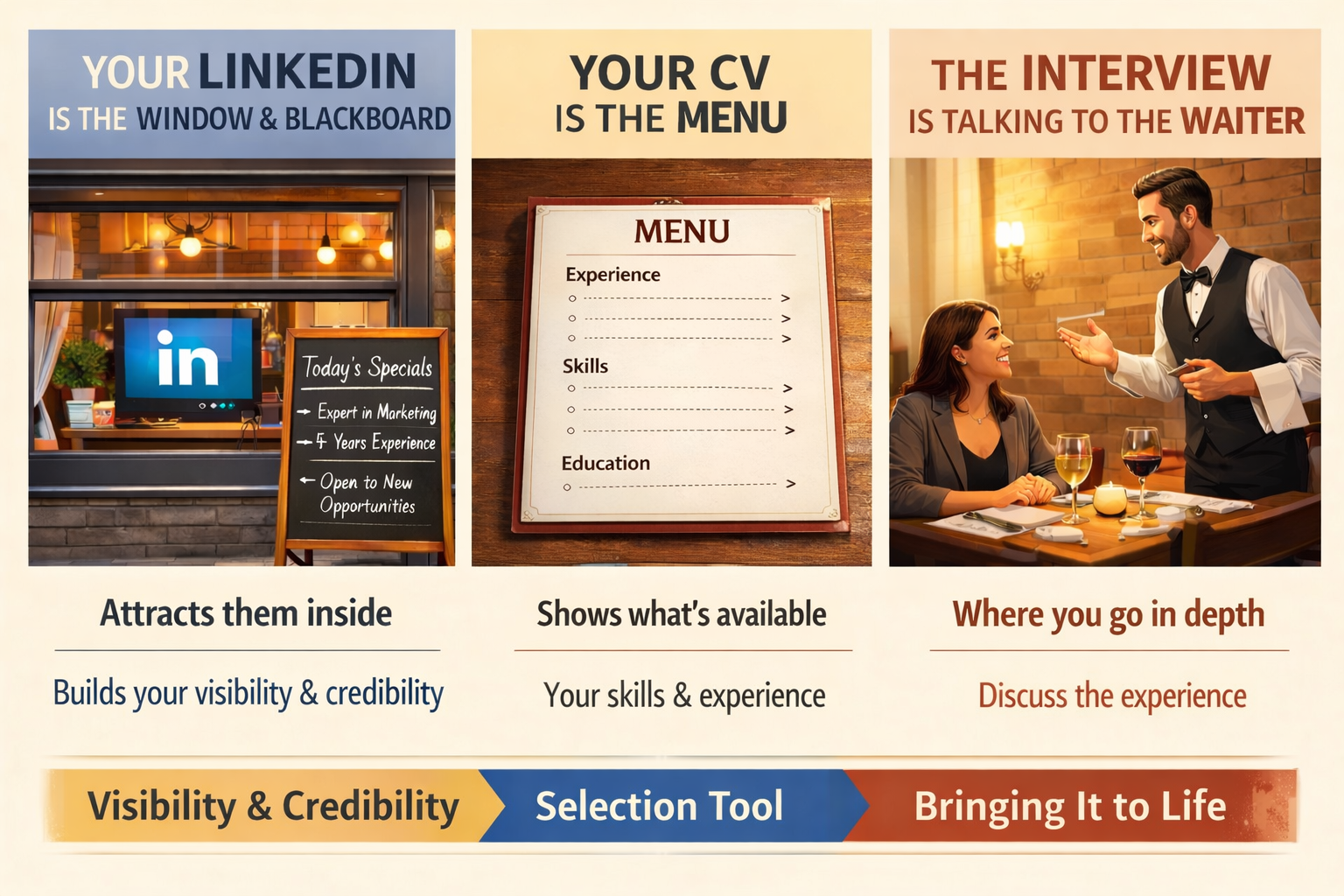
Putting it all together
The best restaurants succeed because every touchpoint works in harmony — in the right order. The chalkboard brings you in. The menu builds excitement. The waiter seals the deal. If any one of those elements is weak, the whole experience suffers — no matter how good the food actually is.
Your job search is no different. You might have world-class skills, but if your LinkedIn profile doesn’t stop the scroll, people will never find your CV. If your CV doesn’t clearly communicate your value, you’ll never get the interview. And if you can’t bring your CV to life in conversation, you won’t get the offer.
Audit all three — in order. Are they working together? Do they tell a coherent, compelling story? Get the whole restaurant right, not just the food.
Quick self-audit
Start outside: read your LinkedIn headline as a stranger walking past — would you stop? Then open your CV — does it read like a menu worth ordering from? Finally, think about your last interview — did you bring the dishes to life, or just recite the ingredients?
Looking for your next role and need some help? I offer a free introductory chat — no obligation, no pressure. Get in touch and let's have a conversation. → Get in touch